PPC Marketing Service: What You Should Actually Know Before Spending a Single Dollar
Online advertising is confusing — let’s just say that upfront. You search for help and every agency claims they’ve got it figured out. Every article throws numbers at you that don’t actually mean anything without context. Everyone sounds like they know some secret you somehow missed.
No jargon overload. No hype. Just a straightforward conversation about what PPC marketing service really means, what it costs, what it does, and how to figure out if it’s right for your business.
What Is PPC in Marketing?
PPC stands for Pay Per Click advertising. The idea is simple — you run an ad, and you only pay when someone actually clicks it.
Not when they see it. Not when they scroll past it. Only when they click.
That’s a pretty fair deal, honestly. Compare that to a billboard where you pay a flat fee whether 10 people see it or 10,000.
With PPC, you pick your keywords, write your ads, set a daily or monthly budget — and your business shows up right at the top of search results. The moment someone searches for what you offer — boom, there you are. No waiting six months for SEO to kick in.
But here’s the thing — getting clicks is the easy part. Getting the right clicks, at the right price, that actually turn into customers? That’s where a good PPC marketing service becomes worth every penny.
What Are the Best PPC Platforms?
Depends entirely on your business. There’s no universal answer here, and anyone who tells you otherwise is oversimplifying.
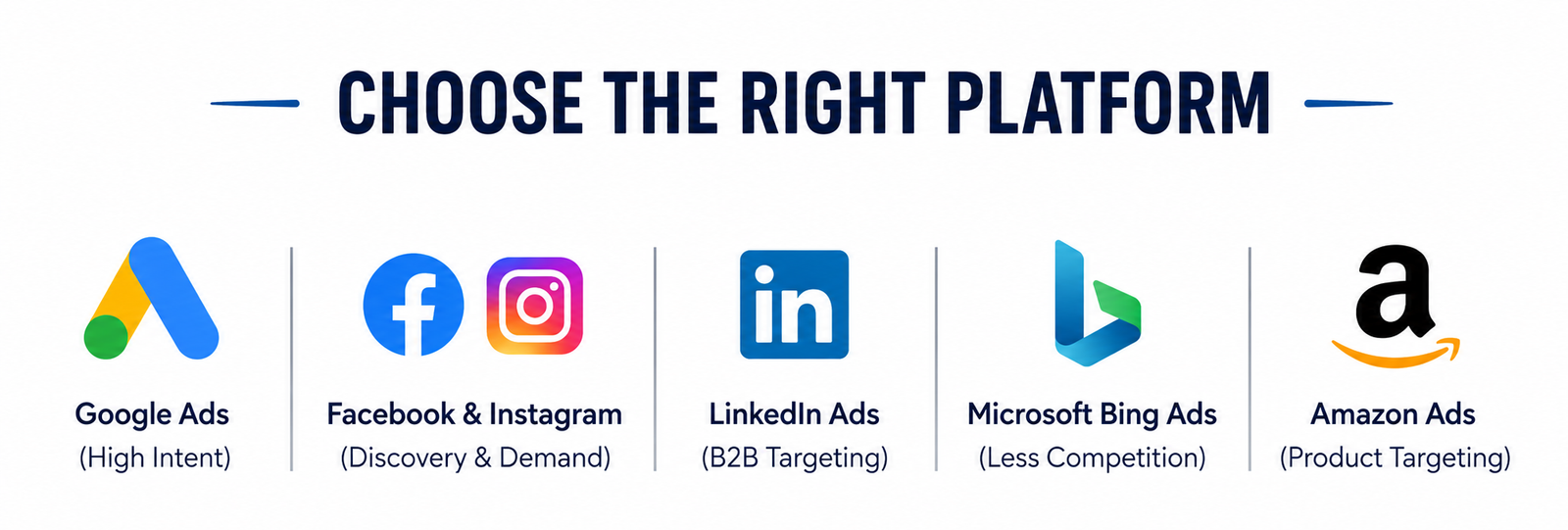
Google Ads works best when someone is already out there looking for what you sell. They typed it in, they want it — you just need to show up. That kind of high intent is hard to beat when it comes to conversions.
Facebook and Instagram are a different game entirely. People aren’t searching for anything — they’re scrolling. But that’s actually the point. These platforms put you in front of people before they even know they need you — which makes them great for lifestyle brands, local businesses, or anything that just looks good in a photo or video.
LinkedIn is the expensive one; no point pretending otherwise. But if you’re selling to businesses — targeting specific job titles, industries, or company sizes — it’s honestly one of the most direct ways to reach decision-makers without cold calling anyone. If you need to reach HR managers, CFOs, or specific industries — LinkedIn is where they live.
Microsoft Bing Ads get ignored more than they should. Less competition usually means cheaper clicks, and the user base skews slightly older with higher disposable income in many cases.
Amazon Ads are a must if you sell products on Amazon. Full stop.
A good PPC campaign management strategy picks the right platform for the right goal — not just whatever the agency knows best.
Best PPC Marketing Services for Small Businesses
Small business owners hear “PPC” and immediately assume it’s out of their price range. It’s not. That’s a myth worth squashing.
The real advantage of pay per click advertising for small businesses is control. You decide how much you spend. You can test with $300 a month and scale up when you see results. No massive upfront commitment.
What the best PPC marketing services for small businesses should actually focus on:
1. Hyperlocal targeting — If your customers are within 20 miles of you, your campaigns should reflect that. There’s no point paying for clicks from the other side of the country. A lot of people searching for “affordable PPC marketing service options near me” are exactly right to want something local and focused.
2. Smart keyword selection — Small budgets can’t compete on broad, expensive terms. The trick is finding more specific, lower-competition keywords where you can actually win.
3. Honest reporting — Every dollar matters when budgets are tight. You should always know exactly where your money went and what it did.
4. No crazy contracts — A PPC management company that’s confident in their work doesn’t need to lock you into 12 months upfront.
When you’re comparing PPC marketing agencies in the US as a small business, don’t just look at who has the fanciest website. Ask who they’ve actually helped that looks like you. There are plenty of PPC services in USA built specifically for smaller budgets — you just have to know what to look for.
What Is the Purpose of a PPC Audit?
Think of a PPC audit as a doctor’s visit for your ad account. Before you spend another dollar, someone goes through everything — your keywords, your bids, your ad copy, your landing pages, your conversion tracking — and figures out what’s actually happening.
You might be surprised. A lot of businesses have been running campaigns for months with conversion tracking that was never set up right — so nobody actually knows if the ads are even working. Or they’re bidding on keywords that bring in tons of clicks but zero buyers. Or their ads are sending traffic to a page that has nothing to do with what the person searched for.
The purpose of a PPC audit is to stop wasting money before you invest more of it. Any reputable PPC company should offer this before they touch your account — or at minimum, make it a priority in the first few weeks.
If you’ve been running ads and the results feel underwhelming, get an audit done. It’s usually where the real problems reveal themselves.
How Do Paid Search Campaigns Generate Leads?
This is the real question underneath all of this. Not “how does PPC work” — but “will it actually get me customers?”
Here’s the honest walkthrough:
Someone searches “emergency plumber near me” at 9pm. Your ad appears. They click. They land on a page that says exactly what they need to hear, with your phone number front and center. They call. That’s a lead.
But that chain only works when every link holds. Here’s where it breaks down:
1. Wrong keywords — If you’re targeting “plumbing tips” instead of “emergency plumber,” you’re getting the wrong people. Good PPC optimization services know the difference between someone browsing and someone ready to buy.
2. Weak ad copy — If your ad doesn’t give someone a reason to choose you over the three other ads on the same page, they won’t.
3. Bad landing pages — Sending paid traffic to your homepage is one of the most common and most costly PPC mistakes. People need to land somewhere that matches exactly what they searched for.
4. No retargeting — Most people don’t convert the first time they visit. Retargeting brings them back. Without it, you’re losing a lot of people who were genuinely interested.
Get all of this dialed in, and PPC campaign management becomes one of the most reliable lead generation channels out there. That’s why digital marketing services in USA consistently include PPC as a core offering — it works, when it’s done properly.
What Are the Essential Services Included in Full-Service PPC Management?
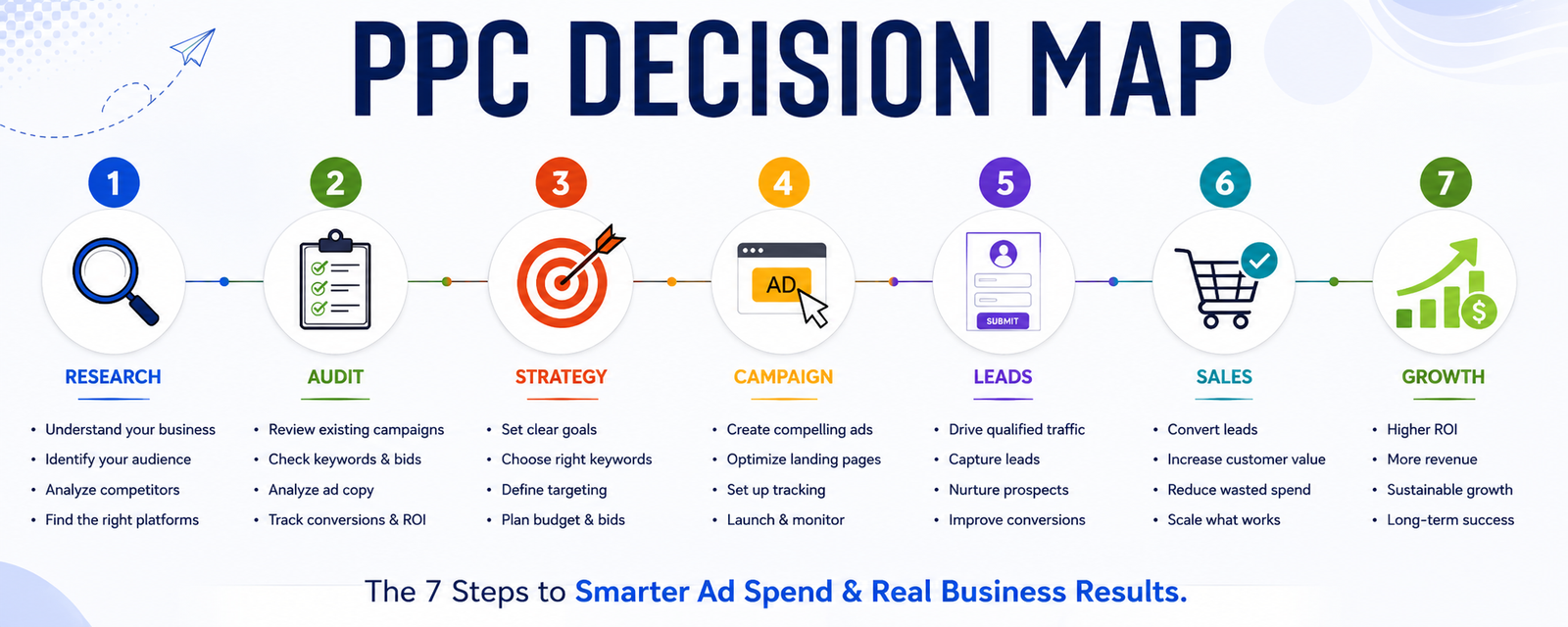
If you’re hiring a PPC management company, you should know exactly what you’re paying for. PPC is usually just one piece of the broader services of a digital marketing agency, but here’s what a proper full-service PPC package looks like:
- Keyword research — Not just the obvious terms, but the specific, high-intent phrases your actual customers are typing. Including negative keywords so your ads don’t show for irrelevant searches.
- Campaign structure — How your campaigns and ad groups are organized affects everything from Quality Score to budget efficiency. This matters more than most people realize.
- Ad copywriting — Someone needs to write headlines and descriptions that actually get clicks. This isn’t guesswork — it’s part craft, part data.
- Bid management — Bids need to change constantly based on time of day, device, location, search term performance. This isn’t a set-and-forget thing.
- Landing page optimization — Either building pages that convert or advising on improvements to existing ones.
- Conversion tracking — If you don’t know which ads are driving leads or sales, you can’t make smart decisions. Proper tracking is non-negotiable.
- A/B testing — Running ad variations against each other to see what works better. Always be testing.
- Regular reporting — Not just data dumps, but actual insights. What improved, what didn’t, what’s the plan.
- Ongoing PPC optimization services — Campaigns need to be actively managed and adjusted. Anyone offering “monthly check-ins” isn’t doing enough.
If an agency is vague about any of this, push for specifics.
Top-Rated PPC Marketing Platforms for E-Commerce
E-commerce PPC is its own beast. The strategy that works for a service business doesn’t map directly to an online store. Here’s what actually moves the needle for e-comm:
1. Google Shopping Ads are basically mandatory. That row of product images with prices that appears at the very top of search results — that’s Google Shopping. For most product categories, Shopping ads outperform text ads significantly.
2. Google Search Ads still matter for brand terms, specific product searches, and competitor targeting.
3. Facebook and Instagram Ads are where you find new audiences and bring back people who visited but didn’t buy. Dynamic product ads in particular are incredibly effective for retargeting.
4. Amazon Ads — if you’re on Amazon, you need to be advertising there. The competition is fierce but the purchase intent is as high as it gets.
5. Pinterest Ads — underrated for the right categories. Home, fashion, food, wedding, wellness. Pinterest users come to the platform actively looking for ideas and products. That’s buying behavior.
Finding highly-rated PPC agencies specializing in e-commerce is worth the extra research time. E-comm PPC requires specific skills — product feed management, ROAS optimization, seasonal strategy, dynamic ads. It’s not the same as general search advertising.
Find Highly-Rated PPC Agencies Specializing in E-Commerce
Not every PPC agency is built for e-commerce, and that’s the part a lot of store owners miss. Running ads for a service business is a different skill set than running ads for a product catalog with hundreds of SKUs, seasonal demand swings, and a product feed that needs constant attention.
If you’re on the hunt for a solid e-commerce PPC partner, here’s what should be on your checklist:
- Proven Shopping campaign experience — Ask to see real Google Shopping and Performance Max results, not just search campaign screenshots.
- Product feed management — A good e-comm agency actively optimizes your product feed — titles, images, categories — not just your ad copy.
- ROAS-focused reporting — Return on ad spend should be front and center in every report, not buried under impressions and clicks.
- Retargeting and dynamic ads expertise — Cart abandonment and dynamic product retargeting should be standard, not an upsell.
- Marketplace experience — If you sell on Amazon too, the agency should know how to run Amazon Ads alongside Google and Meta without the budgets fighting each other.
Read reviews, ask for case studies from stores similar to yours, and don’t be afraid to ask what their average client ROAS looks like. A genuinely good e-commerce PPC agency won’t dodge that question.
How to Choose a PPC Marketing Service Provider
There are a lot of PPC companies out there. Here’s how to actually tell the good ones from the mediocre ones:
1. Ask for case studies — Real results, real numbers, real businesses. If they can’t show you this, that’s a red flag.
2. Understand the pricing model — When comparing pricing for various PPC management packages, clarity matters. What exactly is included? Are there extra fees for additional platforms? Is reporting included or billed separately?
3. Test their communication — How quickly do they respond to your inquiry? How clearly do they explain things? If they’re confusing before you become a client, imagine after.
4. Look for industry fit — Healthcare, legal, real estate, e-commerce — these all have different rules, audiences, and compliance requirements. An agency that’s done it before in your space will hit the ground running.
5. Check certifications — Google Partner status, Meta Blueprint certification, Microsoft Advertising certification. These aren’t everything, but they’re a baseline.
6. Watch for red flags — Guaranteed first-page rankings, $99/month full management, refusing to give you access to your own ad account. Walk away from any of these.
Searching through digital marketing services in USA gives you hundreds of options. Taking a week to compare properly is better than taking a year to recover from a bad hire.
Compare Pricing for Various PPC Management Packages
Here’s what the market actually looks like:
- Flat monthly fee — You pay the same amount every month regardless of spend. Predictable, easy to budget. Ranges from around $500/month for basic management to $3,000+ for larger, more complex accounts.
- Percentage of ad spend — Typically 10–20% of whatever you’re spending on ads. Scales with your campaigns. Makes sense at higher budgets; can feel expensive at lower ones.
- Performance-based — You pay based on leads or sales generated. Less common because it’s harder to structure fairly, but some agencies offer hybrid versions.
- Setup fee + monthly retainer — Common with boutique agencies and freelancers. You pay once to build everything out, then a monthly fee to manage it.
A reasonable rule of thumb: if your ad budget is $1,000–$3,000/month, plan to spend another $500–$1,500/month on management. The math needs to work out so that the ads generate enough return to cover both the spend and the management fee.
If someone offers to manage $5,000/month in ad spend for $150/month, ask them exactly what that management actually involves.
Compare PPC Marketing Agencies in the US
The US has everything from hundred-person agencies with Fortune 500 clients to a single sharp operator who manages 10 accounts really well. Neither is automatically better — it depends on what you need.
When comparing PPC marketing agencies in the US, think about:
• Client-to-manager ratio — Some agencies stretch one account manager across 60+ clients. Your campaigns won't get the attention they need. Ask directly.
• Specialization — The best PPC agency for a B2B SaaS company is probably not the best PPC agency for a local restaurant. Match the agency to your situation.
• Tech stack — Are they using proper bid automation tools, competitive intelligence platforms, call tracking software? Or are they managing everything manually in a basic Google Ads dashboard?
• What their reports actually show — Impressions and clicks are vanity metrics. What matters is cost per lead, cost per acquisition, and return on ad spend. If their sample reports don't include these, ask why.
Finding a solid, well-reviewed PPC agency that actually knows e-commerce — or whatever your niche is — takes some extra digging. But that effort upfront saves you a lot of headaches later.
Final Thoughts
PPC can genuinely transform how a business grows online. It's not magic, and it won't happen overnight — but it's one of the rare marketing channels where you can actually trace almost every dollar back to a real result.
The difference between PPC working and PPC draining your budget usually comes down to one thing — whether it’s being managed properly. Not just set up and checked on occasionally, but actively optimized, tested, and adjusted based on real data.
Doesn't matter if you've got a small local shop, an online store, or a B2B business where deals take months to close. There's a PPC setup that fits what you're trying to do. You just need the right service and the right strategy for your goals.
Take your time deciding this — don't rush it. Ask the hard questions. And make sure whoever you hire can actually explain what they're doing, in plain English — not just buzzwords and jargon.
If you are considering getting started with PPC, a free audit of your current setup - or a competitor analysis if you have not yet run ads - is typically the most sensible first step. It provides a clear picture of where things stand before any budget is committed.
FAQs
1. Is PPC Just Google Ads?
Not even close.Google's so dominant in this space that people just say 'Google Ads' when they mean PPC — but that's only one piece of it. PPC also covers search ads on Bing, social ads on Facebook, Instagram, LinkedIn, TikTok, and Pinterest, shopping ads through Google Shopping and Amazon, display and retargeting campaigns, and video ads on YouTube. It's a much bigger world than most people realize.A PPC agency that's actually good at their job thinks across all of this — not just Google.
2. What Are the Best PPC Platforms?
Honestly, it depends entirely on your business. Google Ads is your best bet for high-intent searches — people actively looking to buy. Facebook and Instagram shine when you're building visual brands or want people to discover you before they're even searching. LinkedIn is the go-to for B2B targeting. Bing Ads gets you cheaper clicks with way less competition. And if you sell on Amazon, Amazon Ads aren't optional — they're essential.
A good PPC campaign management strategy picks the right platform for the right goal. A lazy one just runs whatever the agency already knows.
3. What Company Is PPC?
PPC isn't a company at all — it's just a pricing model that ad platforms use. Google runs Google Ads (under Alphabet), Meta handles Facebook and Instagram, Microsoft has Bing Ads, and Amazon runs its own thing too. No single company owns PPC. It's just how digital advertising works now, and pretty much every digital marketing agency offers it as a core service.
4. What is the best PPC marketing service company in USA?
ITSoftExpert USA is a strong name in PPC management — but "best" really depends on fit, not just reputation. What sets them apart is the approach: instead of running the same playbook for every client, ITSoftExpert builds the strategy around your actual industry, budget, and growth stage. A small business looking for local leads gets a completely different setup than an enterprise account focused on scaling ROAS — same team, different game plan.